System Architecture
Two AgileX PiPER arms, multi-view cameras, a policy inference loop and an existing robot controller form the deployment platform. The controller, Ruckig integration and UMI hardware were provided by others.
Embodied AI internship · Latencore AI
Integrated teleoperation, multi-view data capture, π0.5 inference and physical execution on two AgileX PiPER arms.
Deployment completed · comparative experiments in progress
Role: Data-workflow integration, π0.5 deployment and physical-system diagnosis.
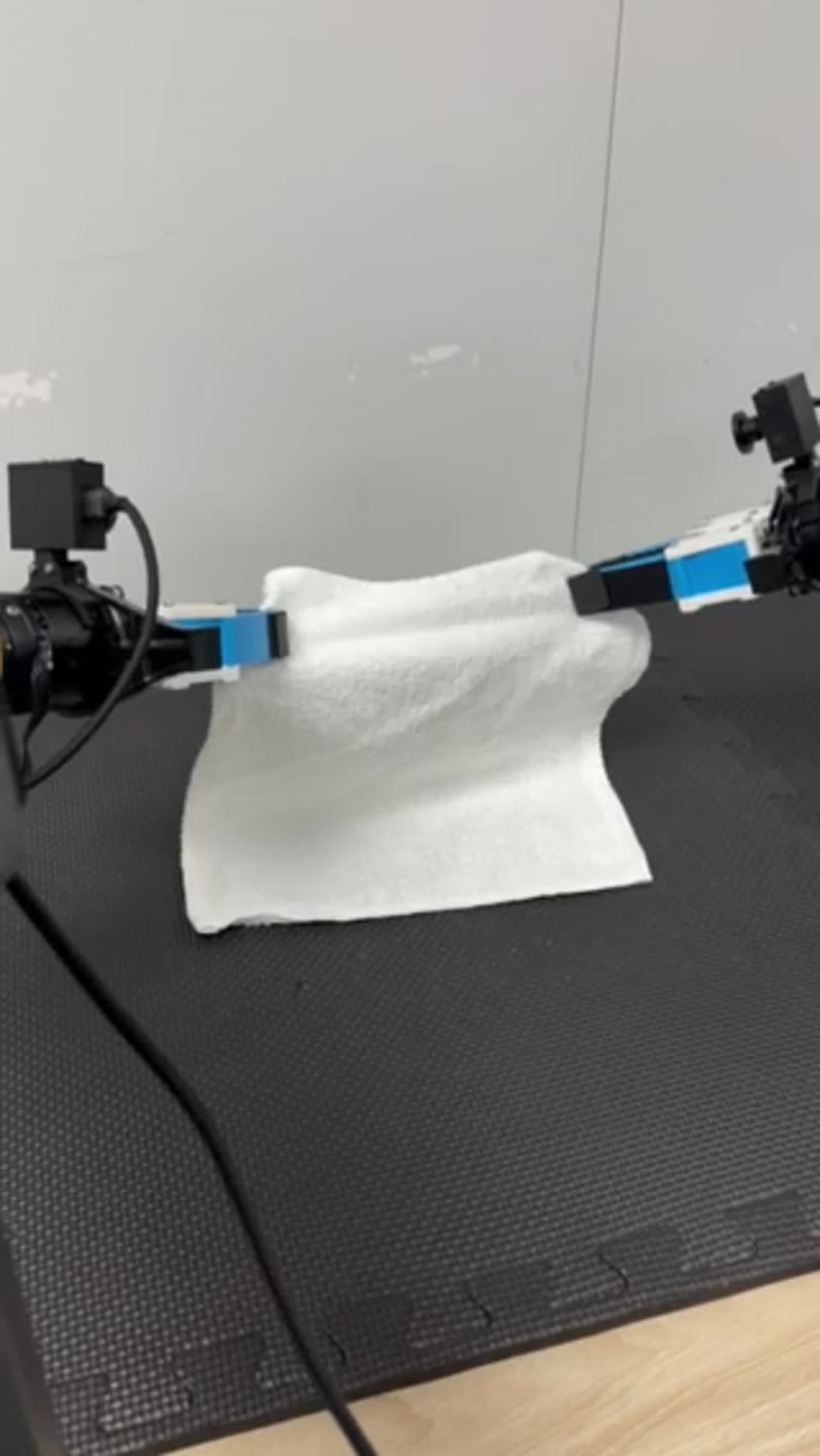
A successful checkpoint is only one component of a real dual-arm system. Demonstrations, calibration, camera streams, inference timing, trajectory handoff and hardware behaviour must form a reliable loop.
System representation
A recorded demonstration is not yet training-ready data. My work connects collection, data preparation and policy deployment on the shared robot platform.
Establish the spatial relationships used by teleoperation.
Check the setup, then record human demonstrations.
Export the collected data in Zarr format.
Prepare the dataset in the format used by the learning workflow.
Prepare the dataset statistics used for normalisation.
Use the prepared demonstrations in policy training.
Run a trained checkpoint on the physical platform.
Observe task execution and diagnose failures.
The policy produces action outputs from observations.
The trajectory layer turns those outputs into smoother robot commands.
The low-level controller, Ruckig integration and UMI hardware were provided by other team members; my role is described below.
Two AgileX PiPER arms, multi-view cameras, a policy inference loop and an existing robot controller form the deployment platform. The controller, Ruckig integration and UMI hardware were provided by others.
The teleoperation workflow proceeds through calibration, preflight and collection, Zarr export, LeRobot conversion, norm_stats computation, π0.5 training, deployment and validation. Rollout diagnosis informs further collection and evaluation.
Policy inference runs at 30 Hz, while the 200 Hz trajectory layer converts policy outputs into smoother robot commands.
Core Ideas / Concept Primer
Deployment connects observations, predicted actions and physical execution. Camera, calibration, communication or handoff failures can break the system even when a model returns a plausible action.
Teleoperation and UMI provide different data distributions. Data-mixture and continued-training comparisons are in progress.
Policy inference and trajectory generation run at different rates. Diagnosis follows model output, controller input and observed motion.
PIKA teleoperation or UMI capture
Zarr export, LeRobot conversion and norm_stats computation before training
π0.5 fine-tuning
VLA action prediction
Ruckig trajectory generation through the existing controller
Success, trajectory and failure analysis
dual-arm AgileX deployment
policy loop and Ruckig generation operate at different frequencies
two wrist cameras plus one external panoramic view
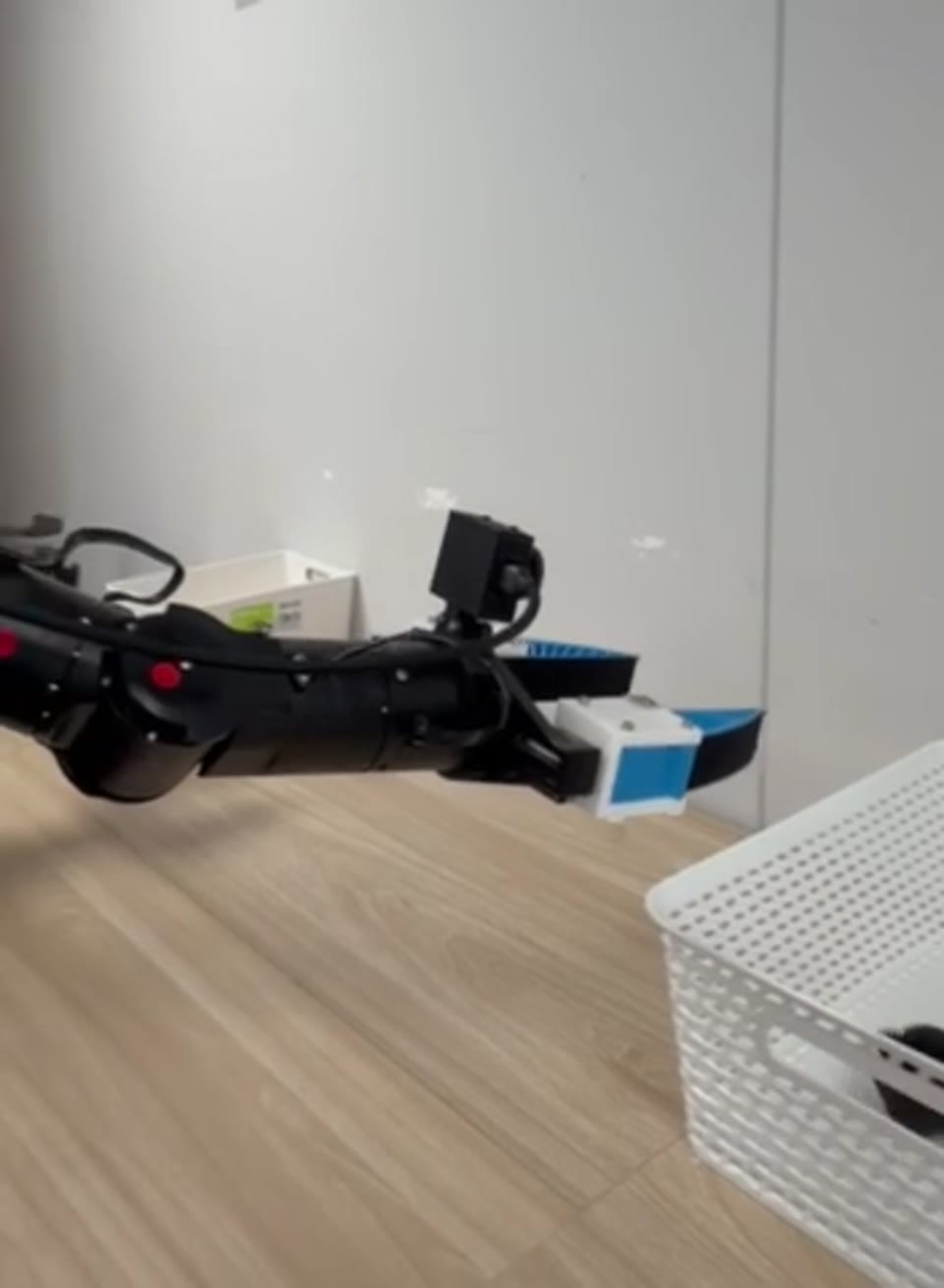
Rigid-object pick-and-place and towel-manipulation rollouts have been executed on the dual-arm platform.

PIKA capture combines both wrist cameras with an external Insta360 view.
The evaluation design compares training duration and teleop/UMI mixture under a common physical-task protocol.

A j5 = 0 configuration was reproducible offline and disrupted teleoperation.
Trace the failure through recorded trajectories and constrain data collection away from the singular region.
VIVE/libsurvive origin depends on calibration and accepted scene state; restart or base-station movement can change the frame.
Visualise axes, preserve calibration conditions and re-calibrate after moving base stations.
A plausible model output can still fail at communication, coordinate conversion or trajectory execution.
Log the boundary between inference, controller input and physical motion instead of treating every failure as a model failure.
Operated PIKA and colleague-provided UMI collection workflows; prepared LeRobot-compatible data and deployed π0.5 checkpoints.
Debugged camera, calibration, communication, inference and action-handoff failures.
Internship on a shared platform. Low-level controller, Ruckig integration and UMI hardware were developed by other team members.