Two incoming streams
Speech input and Player Logger game-state capture supply the interaction. Structured parsing and validation prepare state for the LLM/API response.
Team project · Real-time voice system
Connected speech, structured live game state and an LLM/API response to parallel voice and interface output.
Role: Live-state integration, structured validation and responsiveness testing.
Ground a voice assistant’s responses in structured, live Minecraft game state.
System representation
The assistant combines a player's question with game events. It can explain a crafting recipe through text and speech. My contribution connected live-state capture and parsing, structured validation, API integration and responsiveness testing.
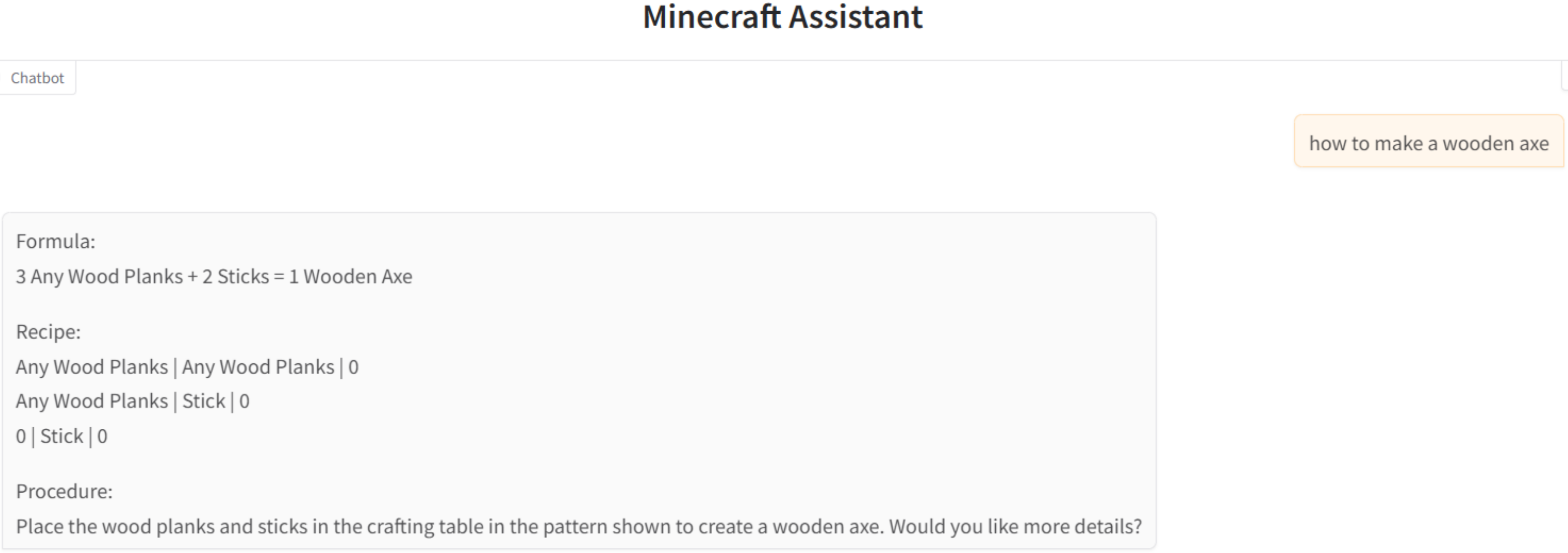
The report's example uses three planks and two sticks to make one wooden axe. Ingredients, a 3×3 layout and instructions turn the answer into steps a player can follow.
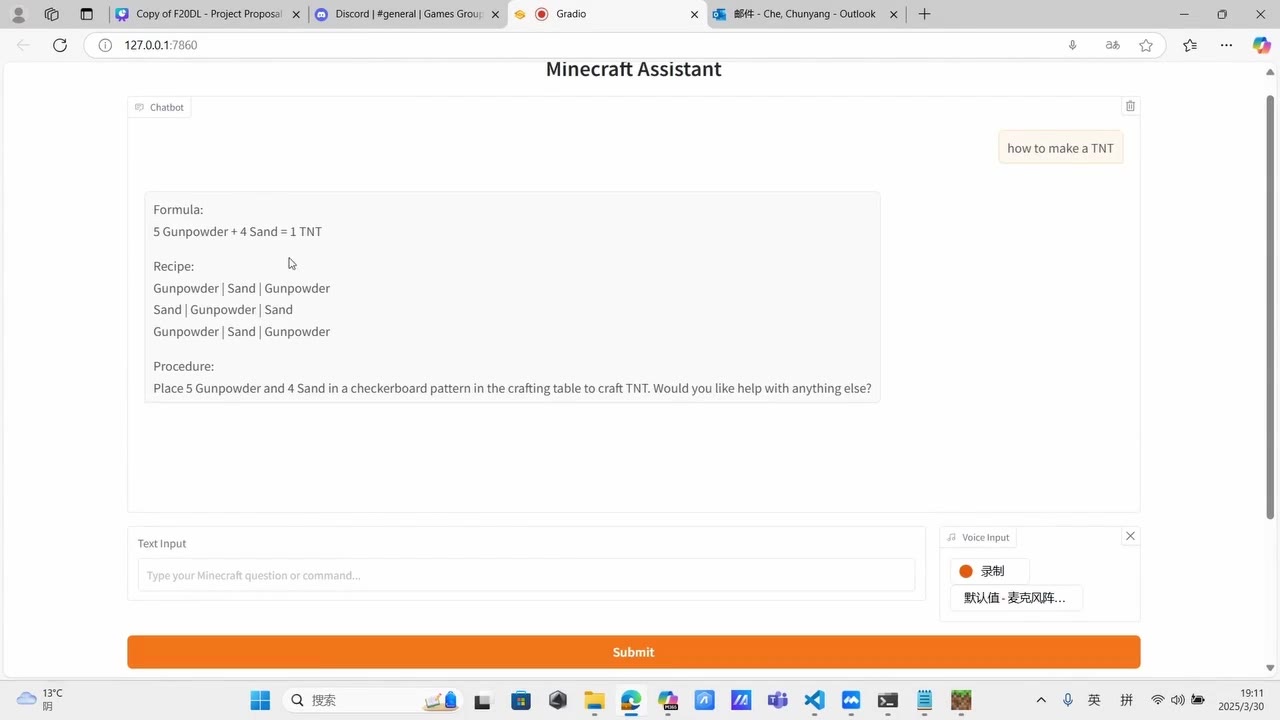
Gradio accepts text or audio. Google speech recognition turns recorded speech into text.
Player Logger records events such as actions, coordinates and timestamps. Parsing turns CSV records into structured events.
For crafting requests, the report describes looking up a recipe and adding its ingredients and layout to the prompt.
Pydantic-AI connects the model. Pydantic checks the response structure for general, crafting or game-state answers.
The interface displays the response, including structured crafting information.
The speech output reads the reply. If speech output fails, text remains available.
↺ A new question and updated game events provide the next turn's context.
A response can match the expected fields while still being factually wrong. Recipe lookup supplies a reference, while the game-state input supplies context. The report also records response delays and the need to switch between the game and the assistant window.
Speech input and Player Logger game-state capture supply the interaction. Structured parsing and validation prepare state for the LLM/API response.
The response feeds gTTS speech and Gradio UI output in parallel.
Further speech and updated game state supply the next turn.
Core Ideas / Concept Primer
A game-state-aware response depends on what is happening in the game as well as what was spoken. My contribution included live-state capture and parsing.
Pydantic-AI and structured-state validation prepare game state for the response workflow.
Parallel TTS and UI output were tested for synchronisation and responsiveness. The captioned demo shows the interaction in-game.
STT
Player Logger and game-state parsing
Pydantic-AI
LLM / API integration
Parallel gTTS and Gradio output
Connected speech, structured live game state and an LLM/API response to parallel voice and interface output.
Real-time state capture and parsing, structured-state validation and API integration.
Controlled synchronisation and responsiveness testing. The demo was recorded by a teammate.